
5 Patterns Neurodivergent Professionals May Rely on at Work
Quick Summary:
Patterns of Divergent Minds at Work™ five patterns - Architect, Rescuer, Visionary, Adapter and Imposter—are offered as a reflective lens.
A workplace strategy can be effective and demanding at the same time. An approach that helps you lead, solve problems or maintain trust may become harder to sustain when you have to rely on it too heavily.
Workplace conditions matter. Workload, unclear expectations, communication norms, sensory demands, team dynamics and limited support can influence which patterns become more active and how much effort they require.
More than one pattern may apply. Your responses can change depending on your role, environment, responsibilities and the demands you are managing.
The goal is greater choice, not eliminating what works. Recognizing a pattern can help you understand what it is doing for you and consider what could change in your response, your environment or both.
A project changes direction halfway through, but no one is quite clear about who owns the new decisions. Your team is already stretched, another urgent issue has landed in your inbox, and tomorrow's leadership meeting requires you to be ready for questions that may or may not come.
You respond using strategies that have served you before. Perhaps you rebuild the plan so the ambiguity feels manageable, step in to solve the problem because waiting could put the deadline at risk, or generate several possible ways forward. You might adjust your communication for the people in the room or spend another hour preparing because arriving without every answer does not feel like an option.
From the outside, these responses can look like competence, and often they are. But they can also require considerably more effort than anyone else sees, particularly when they become the strategies you rely on whenever pressure, uncertainty or complexity increases.
Patterns of Divergent Minds at Work™ grew from recurring workplace strategies Cathy Rashidian observed across thousands of coaching hours, initially in her work with professionals with ADHD. These observations were later examined through a broader neurodivergent lens and informed by workplace research.
The five patterns are Architect, Rescuer, Visionary, Adapter, and Imposter, which are offered as a reflective lens. They are not personality types, a validated psychological framework or a diagnostic model.
Understanding the patterns can help shift the question from Why do I keep doing this? Toward something more useful: What is this strategy helping me manage, and what conditions are making me rely on it so heavily?
Why work patterns matter for neurodivergent professionals
It is easy to look at a workplace difficulty and assume the solution lies entirely with the individual. If you are overwhelmed, manage your time better. If you struggle to delegate, learn to let go. If meetings exhaust you, improve your communication skills.
But workplace conditions also affect how you work. A manager who frequently changes priorities may make additional planning necessary, while an understaffed team may repeatedly pull a capable colleague into problems that technically belong elsewhere. Communication norms that reward immediate verbal responses can increase the amount of preparation some professionals need before meetings, and noisy offices, constant interruptions or back-to-back calls can consume capacity before the most demanding work of the day even begins.
For executive leaders, ambiguity may also be an unavoidable part of the role. Decisions often need to be made with incomplete information, competing stakeholder needs, and consequences that extend beyond an individual's own workload.
The demands placed on executive functioning are not created by the individual alone. Executive functions help us hold and work with information, prioritize, plan, shift between tasks, and regulate attention and action. Differences in these functions are strongly associated with ADHD and may also be relevant across other neurodivergent experiences, although the profile varies from person to person.
Planning systems, written processes, and external structure can reduce some of these cognitive demands. But even strong personal systems have limits when ownership is unclear, workloads are unrealistic, or priorities continually change.
How job demands and resources shape sustainable performance
Job Demands–Resources theory offers a useful workplace lens for understanding why individual strategies are only part of the picture. In their 2023 review of developments in JD–R theory over the previous decade, Bakker, Demerouti, and Sanz-Vergel explain that job demands requiring sustained physical, cognitive, or emotional effort can contribute to exhaustion. Job resources, including autonomy, support, and feedback, can help people meet those demands and sustain motivation.
This research did not examine neurodivergent professionals or the five patterns specifically. Instead, it reinforces a relevant workplace principle: the effect of a strategy depends partly on the demands it is responding to and the resources available.
For a neurodivergent professional, the question is therefore not only, “What should I change about how I work?” It is also, “What workplace demands or missing resources are increasing how heavily I need to rely on this strategy?”
This context is also important when looking at the five Patterns of Divergent Minds at Work™. Each pattern reflects a strategy that can help you respond to workplace demands, but may become costly when you rely on it too heavily. Understanding the patterns can help you recognize what your strategies are helping you achieve and where you may have more choice in how you respond.
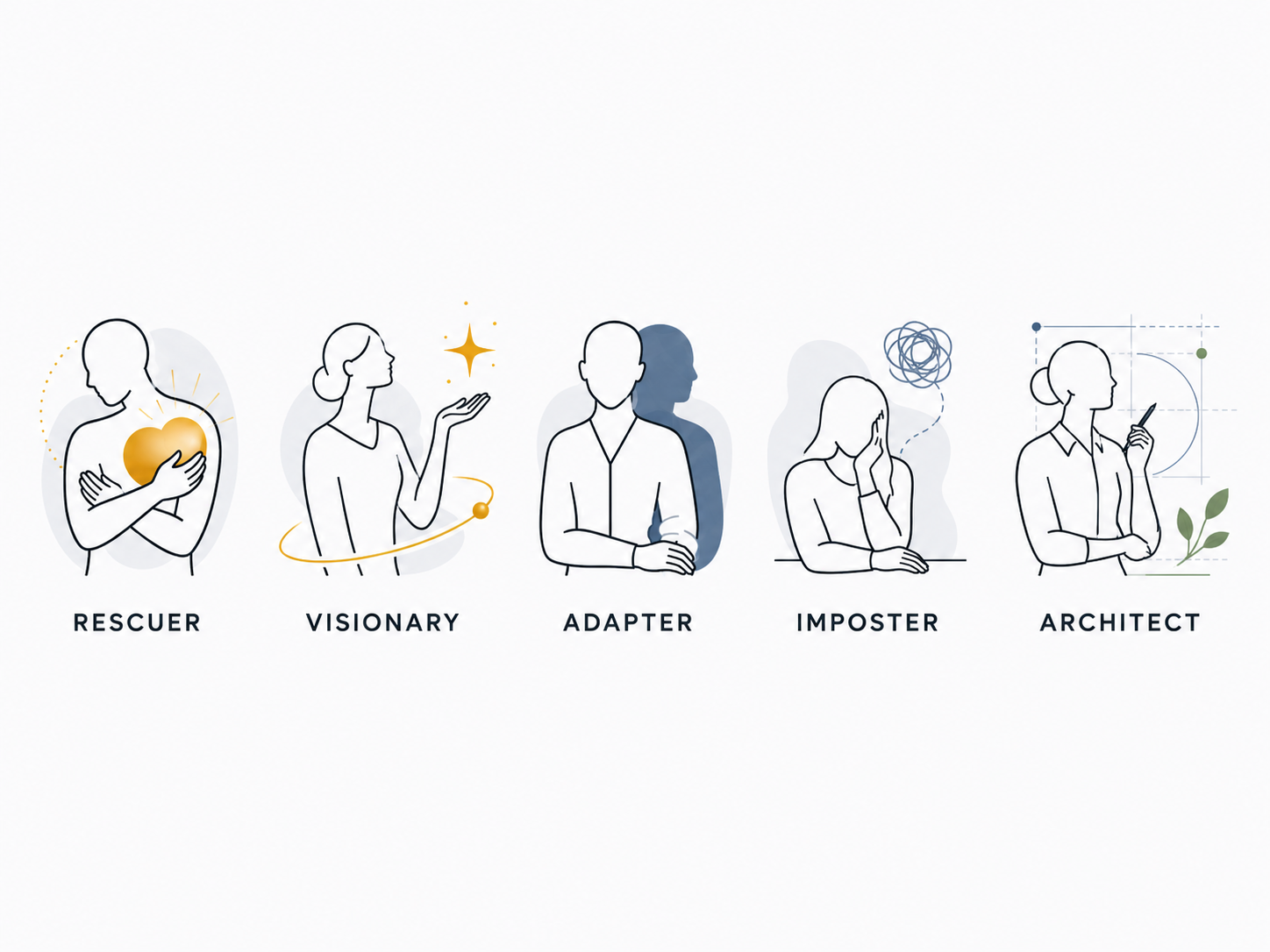
Patterns of Divergent Minds at Work™
Before changing the pattern, identify what the strategy is solving and what in the workplace keeps making it necessary.
1. The Architect
The Architect creates structure to make complex, uncertain, or changing work more manageable. In senior roles, this can be particularly useful when several priorities, stakeholders, and decisions need to stay connected.
What it can look like at work
An Architect may find themselves:
Building project roadmaps or detailed plans
Clarifying roles, ownership, and decision points
Creating systems to track interconnected priorities
Structure can provide practical cognitive support by externalizing information, sequencing decisions, and reducing some of the demands placed on working memory, planning, and follow-through.
When the workplace strategy starts to create strain
The challenge can emerge when maintaining the structure starts requiring too much energy. If priorities repeatedly change without clarity about what should be deprioritized, you may find yourself rebuilding plans, increasing oversight or trying to anticipate every possible outcome.
The workplace itself may be contributing to that response. Unclear ownership, shifting expectations or inconsistent decision-making can create a genuine need for more structure, rather than the issue simply being a tendency to over-plan.
A question to consider
What needs to be clear now, and what can I figure out as I go?
2. The Rescuer
The Rescuer quickly notices what people or projects need and often sees a practical way to help. This can be particularly valuable in leadership and senior roles where spotting a risk early or removing an obstacle can protect an important commitment.
What it can look like at work
A Rescuer may regularly:
Step into projects that have stalled
Solve urgent problems before they escalate
Fill gaps when a team or colleague is struggling
That responsiveness can protect quality and restore momentum. The difficulty comes when helping gradually becomes taking ownership, especially when other people's urgent work repeatedly pushes your own strategic responsibilities aside.
When the workplace strategy starts to create strain
An understaffed team, unrealistic deadlines, unclear responsibilities or weak accountability can make rescuing feel necessary. So the pattern should not automatically be reduced to a personal difficulty with boundaries.
It can be useful to notice when your expertise is genuinely required and when the organization has simply become accustomed to you absorbing the gap.
A question to consider
Does this situation need me to step in, or can I help without taking over?
3. The Visionary
The Visionary sees possibilities, connections, and alternative ways forward. This can be valuable in strategy, innovation and complex problem-solving, particularly when the existing approach is no longer working.
What it can look like at work
A Visionary may be quick to:
Connect information across teams or disciplines
Identify alternative approaches to a problem
Generate several promising directions for a project
The tension often appears when several options are genuinely worth pursuing. New ideas can continue emerging after implementation has begun and make commitment more difficult when choosing one direction means deliberately setting others aside.
When the workplace strategy starts to create strain
A culture that rewards constant ideation without establishing clear priorities or decision points can make it harder to move from exploration into execution.
The Visionary should not be treated as a diagnosis-based trait. ADHD does not automatically make someone creative, and dyslexia does not guarantee big-picture thinking. This pattern describes a workplace response and not a characteristic of a particular diagnosis or neurotype.
A question to consider
What is the priority right now, and which ideas can I come back to later?
4. The Adapter
The Adapter notices the people and context around them and adjusts communication or behaviour accordingly. In senior roles, this flexibility can help someone navigate different stakeholders, organizational cultures and communication styles.
What it can look like at work
An Adapter may regularly:
Change how they present an idea for different audiences
Monitor reactions and adjust during conversations
Judge when to challenge an idea directly and when to take another approach
This flexibility can support collaboration and communication. At the same time, the effort involved in continually monitoring expectations, reactions and social cues may remain largely invisible to other people.
When the workplace strategy starts to create strain
Strain can increase when communication norms are implicit, disagreement carries social risk or neurodivergent communication styles receive limited support. Sensory demands such as noise, interruptions and back-to-back meetings can further reduce the capacity available for navigating those expectations.
Not every form of adaptation should be described as masking. Social flexibility, self-protection and camouflaging may overlap, but they are not interchangeable. The more useful distinction is whether adapting still feels like something you can choose.
A question to consider
Am I adapting because it works for me, or because I feel expected to?
5. The Imposter
The Imposter relies on preparation, dependability and extra effort to establish and protect trust. Even highly experienced professionals may recognize this pattern when a new responsibility or higher-stakes situation creates pressure to demonstrate their capability again.
The Imposter pattern is our name for a recurring reliance on preparation, dependability and extra effort. It does not suggest that everyone who recognizes this pattern experiences imposter syndrome.
What it can look like at work
The Imposter pattern may involve:
Preparing extensively for important meetings
Checking work beyond what the task requires
Putting in additional effort to ensure you appear dependable
Preparation can support organization, working memory, processing, and attention to detail. The question is not whether preparation is useful, but how much preparation the situation requires and what is driving the need for it.
When the workplace strategy starts to create strain
The key is understanding why that extra effort feels necessary. Preparation can become costly when it shifts from supporting the work toward protecting your right to be trusted with it.
Previous criticism, workplace bias or environments where mistakes are heavily punished may reinforce this response. Consider which efforts genuinely support your work and which are driven by the need to demonstrate your capability.
A question to consider
What does this task actually require, and what am I adding because I feel I need to prove myself?
You can recognize several patterns at once
Professional responses rarely follow only one pattern, which is why Patterns of Divergent Minds at Work™ looks across all five rather than asking someone to choose one.
Consider a director leading an organizational change. They may become an Architect while creating clarity across a complicated project and move toward the Rescuer when another team falls behind. In executive meetings, they may rely more heavily on the Adapter while monitoring how their recommendations are received, and before presenting to the board, the Imposter pattern may increase how much preparation feels necessary.
These responses can coexist because they are strategies rather than identities. They can also shift as the environment changes. A supportive manager, clearer authority, or a more realistic workload may reduce the need for one strategy, while a promotion, restructuring, a new stakeholder relationship, or a prolonged period of uncertainty may bring another forward.
People with the same diagnosis or neurodivergent identity may rely on different patterns, while similar patterns may appear across different neurotypes for different reasons. Patterns of Divergent Minds at Work™ should not be used to determine how neurodivergent someone is or to identify ADHD, autism, dyslexia, OCD or another condition.
It is a coaching-derived reflective lens, informed by workplace research and intended to provide a starting point for deeper exploration.
How workplace conditions shape work patterns
Recognizing a pattern can create an immediate urge to stop it. Before changing the behaviour, it is useful to understand what the strategy is helping you accomplish and which conditions may be reinforcing it.
There may be an individual response you want to refine, such as pausing before taking ownership, reducing unnecessary preparation or establishing a clearer point at which ideation needs to stop. The conditions around the work also deserve examination.
Clearer expectations might reduce how much planning you need. Better distribution of responsibility could make rescuing less necessary, while explicit communication norms may reduce some of the effort involved in reading the room. Fewer interruptions, more recovery time or changes to sensory conditions may free capacity that is currently being consumed simply by navigating the work environment.
Before changing the pattern, identify what the strategy is solving and what in the workplace keeps making it necessary.
Turn pattern recognition into more intentional choices at work
Recognizing a pattern is not the finish line or simply a result to file away. It can be an initial step in refining the professional skills within that pattern.
An Architect may not need to plan less. They may need to distinguish between structure that supports sound decision-making and additional planning created by unclear ownership. A Rescuer may not need to stop helping. They may need a more deliberate way to determine when their expertise is required and when accountability belongs elsewhere.
The goal is not to replace a successful strategy with generic productivity advice. It is to preserve the capability within the pattern while expanding the ways someone can respond.
See your patterns at work
If you recognize yourself in more than one pattern, the 25-statement reflective inventory can help you see which strategies are currently showing up most strongly and where they may be requiring more effort.
Your results will provide a closer look at your top pattern, what the strategy may be supporting, where strain may be developing and one practical question to explore.
See My Patterns at Work
Disclaimer: Patterns of Divergent Minds at Work™ is a coaching-based reflective inventory. It is not a clinical or psychometric assessment and does not diagnose ADHD, autism, or any other neurological, psychological, or medical condition.
Explore your patterns more deeply through coaching
The inventory can help you recognize a pattern. Coaching helps you explore the deeper nuance: when it becomes active, what it may be helping you manage, what personal or workplace conditions reinforce it, and which changes are realistic within your role.
This is where awareness begins to become a professional-development practice rather than simply information contained in a result or PDF.
Book a coaching fit conversation to discuss what you want to change and whether this coaching approach is the right fit for your needs.
References:
Bakker, A. B., Demerouti, E., & Sanz-Vergel, A. (2023). Job Demands–Resources Theory: Ten Years Later. Annual Review of Organizational Psychology and Organizational Behavior, 10, 25–53. https://www.annualreviews.org/content/journals/10.1146/annurev-orgpsych-120920-053933.
Diamond, A. (2013). Executive functions. Annual review of psychology, 64, 135–168. https://doi.org/10.1146/annurev-psych-113011-143750
FAQs about Patterns of Divergent Minds at Work™
-
No. The five patterns are recurring workplace strategies observed through coaching and offered as a reflective professional-development lens. They are not fixed identities, personality types or a way to diagnose a neurodivergent condition. A pattern describes something you may rely on in a particular context—not who you are or what you are capable of.
-
You may not need to change it. The goal is to recognize when you are choosing a strategy because it fits the situation and when you are relying on it automatically. A useful pattern may need attention when it begins consuming more energy, limiting your options or pulling you away from higher-value work. Greater awareness can help you preserve the capability within the pattern while using it more intentionally.
-
Yes. Different roles, projects, relationships and levels of pressure can bring different patterns forward. You might use the Architect when managing complexity, the Rescuer when a project is at risk and the Adapter when navigating an important stakeholder conversation. The patterns are not mutually exclusive, and they should not be used to place someone into one permanent category.
-
Workload, unclear ownership, shifting priorities, communication expectations, sensory demands, autonomy and available support can all affect which patterns become more active and how much effort they require. This is why reflection should include both the individual strategy and the conditions surrounding it. Sometimes the next step involves changing how you respond; sometimes something in the workplace also needs to change.
-
Start by noticing when the pattern becomes active, what it is helping you manage and what it requires from you. Then consider whether the situation calls for the same response, a smaller version of it or a change in the conditions around you. The inventory can support initial recognition, while coaching can help you explore the deeper context and practise different responses in situations where the pattern is difficult to shift.