
The Rescuer at Work: The Hidden Cost of Becoming Everyone's Problem Solver
Quick Summary:
The Rescuer is a recurring workplace strategy of noticing what people or projects need and quickly stepping in to help.
Solving problems may become one way you demonstrate your value, reliability or commitment at work.
This pattern can restore momentum and protect important work, but support can gradually turn into ownership.
Being valuable does not require becoming responsible for every problem you are capable of solving.
Before stepping in, ask: Is help wanted? Is it mine? Do I have capacity?
Being the person who can solve a problem often feels rewarding. You notice when a colleague is struggling, recognize what a stalled project needs or step in before an important commitment slips. Your response helps the work move forward and people learn that they can depend on you.
After a while, solving problems may become part of how you show your value at work. If you can see what needs to happen, offering help feels like the responsible thing to do. Leaving the problem with someone else may feel uncomfortable, especially when you are concerned about the outcome.
What begins as support can gradually become ownership. You start carrying work that was not yours to handle, while your own priorities are pushed further down the list.
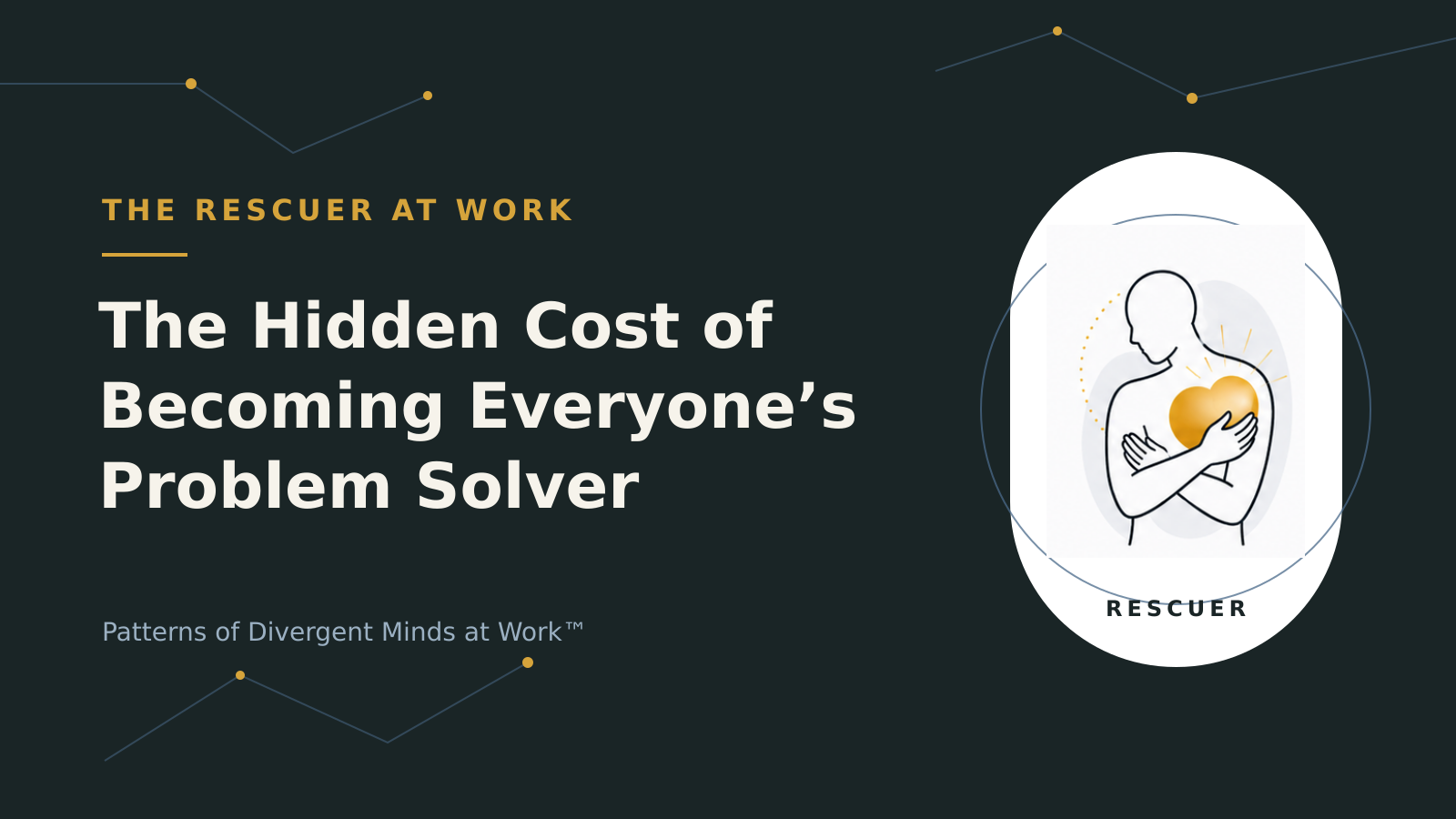
Within Cathy Rashidian’s Patterns of Divergent Minds at Work™, this recurring workplace strategy is described as The Rescuer.
It is not a personality type or an explanation for why someone helps. It describes the experience of quickly recognizing what people or projects need and feeling pulled to step in, sometimes before checking whether support was requested, whether the work belongs to you or whether you have room to take it on.
When solving other people’s problems becomes proof of your value
The Rescuer often appears in ordinary moments. A colleague feels overwhelmed, a project stalls or no one takes ownership, so you step in because you can see a practical way forward.
One decision may be helpful. The pattern becomes clearer when stepping in happens repeatedly alongside your own responsibilities. Your responsiveness earns trust, but it can also create pressure to remain the person who solves the problem.
When helpfulness becomes connected to your value, saying no may feel like letting people down. Others see that the work gets done, but they may not see the priorities you postpone or the attention required to carry responsibilities across the team. Because you continue to deliver, the cost can remain hidden.
Why The Rescuer feels pulled to step in
People may rely on The Rescuer pattern for many different reasons. You might be responding to care, urgency, responsibility, concern about fairness or fear of what could happen if no one acts. You may have experienced what it feels like to need support and not receive it. Your role or workplace may also have taught you that being useful is one of the safest ways to demonstrate your value.
Sometimes the nature of the problem creates its own pull. A colleague’s urgent request is immediate and clearly defined, with a visible result waiting on the other side. Your own priority may be important but slower, more ambiguous or harder to begin. Solving the urgent problem can provide a sense of movement, even though it takes you away from the work that requires your attention.
For some neurodivergent professionals, urgency, a clearly defined problem and an immediate result may make this work easier to engage with than a slower or more ambiguous priority. Differences in how attention responds to urgency and feedback may be one influence, but they are not the only explanation for the Rescuer and should not be inferred from a diagnosis.
The workplace itself can make this pattern stronger. An understaffed team may repeatedly depend on whoever responds fastest. Unclear roles can make it difficult to tell where support ends and responsibility begins. In these environments, your helpfulness may be compensating for missing resources, weak processes or work that has no agreed owner.
The hidden cost of carrying problems that are not yours
Every problem you take on adds more than another task to your schedule. It introduces new details to remember, decisions to follow and outcomes to monitor. A request that takes only a few minutes to address may continue occupying your attention until the situation is fully resolved.
As these responsibilities accumulate, other people’s urgent problems may receive your clearest thinking and best energy. Your own important work is left until later, when you have less focus and more pressure. You may end up working longer hours or rushing to complete priorities that would have been manageable without the additional demands.
Because you still meet your deadlines, it is easy to conclude that you need to manage your time better. The real issue may be that too much unplanned responsibility has entered your workload.
There can also be a cost for the people around you. When you regularly solve problems that someone else could own, that person has fewer opportunities to make decisions, practice new skills or take responsibility for the result. What began as a generous response may eventually become part of how the team operates.
The work may still be getting done, but that does not mean the arrangement is working well. It may depend on you repeatedly absorbing problems before anyone has discussed who should own them.
Three questions to ask before The Rescuer takes over
You do not need to stop being responsive or generous. A short pause can help you decide what kind of support the situation requires and whether you are the right person to provide it.
Before stepping in, ask yourself three questions:
Is help wanted?
You may notice a need before the other person has asked for support. Rather than immediately offering a solution, ask what would be useful. They may want to think aloud, receive feedback on one part of the work or handle the situation themselves.
Is it mine?
A problem can affect your work without becoming your responsibility. Consider who owns the task, decision or outcome. You may have something useful to contribute while leaving responsibility with the appropriate person.
Do I have capacity?
Knowing how to help does not create more time or energy. Look at what you would need to postpone, shorten or carry into your personal time. You may still choose to help, but the decision will reflect your actual capacity rather than the fact that you are capable of solving the problem.
You can also consider why this problem has captured your attention. Is it the need itself, a sense of responsibility, the urgency or the relief of having something clear to solve? If the request feels easier to engage with than your own work, name the priority you would be postponing before deciding what support to offer.
How to remain helpful without becoming the owner
Support can take many forms. You might share a resource, review an outline, help identify the next action or connect the person with someone who can make the necessary decision. Each of these responses contributes to progress without transferring the entire problem to you.
Clear limits make this distinction easier to maintain. You could say, “I can review the outline, but I do not have capacity to complete the draft,” or “I can help you think through the next step, but the decision will need to stay with you.”
This approach does not make your contribution less valuable. In some situations, leaving ownership with the appropriate person may be more useful than taking over. It allows colleagues to build confidence and capability while protecting enough of your attention for the responsibilities that genuinely belong to you.
The Rescuer can continue to support how you work. Your responsiveness may help people feel supported, keep projects moving and protect commitments that matter. Greater choice means deciding when that response fits the situation instead of allowing every visible problem to claim your attention.
Being valuable does not require you to absorb everything that needs fixing. Your judgment about when to help, how much to offer and where ownership belongs is also part of what you contribute.
Discover which patterns you rely on at work
The Rescuer is one of five Patterns of Divergent Minds at Work™. The five patterns describe recurring strategies professionals may use to remain effective when work becomes complex, urgent, unclear or demanding.
These strategies can support strong performance while also requiring more time, energy or effort than other people see. Understanding your patterns can help you recognize what they are doing for you, where they may be creating strain and when another response may serve you better.
Take the free Patterns of Divergent Minds at Work™ inventory to see which patterns are showing up most strongly and receive a closer look at your two highest patterns, including where strain may be developing and one practical question to explore.
FAQs about The Rescuer at work
-
The Rescuer describes a recurring strategy of noticing what people or projects need and quickly seeing a practical way to help. It may support momentum, quality and important commitments. Strain can develop when support becomes ownership before you have considered responsibility, capacity or whether help was requested.
-
Ask what kind of support would be useful before deciding how to respond. You might review an idea, share a resource or help identify the next step. Keep responsibility for completing the task and making decisions with the person who owns the work.
-
Notice whether other people’s urgent problems regularly delay your own important work. Pay attention to responsibilities that continue occupying your thoughts even though you do not own them. Helping may be consuming too much capacity if you repeatedly need to rush, work longer or recover lost time afterward.